Everything you need, one page.
Approved bios, hi-res photos, talk abstracts, and booking details. I reply to media and booking requests within 24 hours.
50 words
Protik Roychowdhury is VP Product at Intellect, a regulated enterprise SaaS platform in workforce mental health with 4.5M+ covered lives and $20M+ ARR, where he leads a team of 20+ and has shipped GenAI features. Previously at Grab and Ola. Three-time founder, one exit. Based in Singapore.
100 words
Protik Roychowdhury is VP Product at Intellect, a regulated enterprise SaaS platform in workforce mental health serving 4.5M+ covered lives across APAC, ANZ, China, and Latam at $20M+ ARR. He leads a team of 20+ across product, design, content, localisation, and AI, and led the product side of the pivot from consumer app to B2B2C. Before Intellect he was Principal PM at Grab, leading Growth, Engagement & Loyalty for the consumer experience, and the first product manager for Rentals at Ola. He is a three-time founder; Croak.it! was acquired by Exotel in 2015. Author of three papers on AI safety and LLM evaluation. Based in Singapore.
250 words
Protik Roychowdhury is VP Product at Intellect, a regulated, multi-tenant enterprise SaaS platform in workforce mental health, regulated as a health platform (provider licensing, PDPA, GDPR, and PIPL data obligations, clinical governance, ISO 27001 and SOC 2), serving 4.5M+ covered lives across APAC, ANZ, China, and Latam. He leads a team of 20+ across product, design, content, localisation, and AI, grown from 3, and led the product side of the company's pivot from consumer app to B2B2C, which took enterprise revenue to $20M+ ARR. He has shipped GenAI features for triage, a chat companion, session preparation, and treatment formatting in a regulated clinical setting.
Before Intellect, Protik was Principal Product Manager at Grab, the Southeast Asian superapp, where he led Growth, Engagement & Loyalty for the consumer experience and Driver Rentals; personalisation lifted onboarding success by 15 points to 94% and a rebuilt billing system saved $4.5M. He was the first product manager for Rentals at Ola, then India's largest ride-hailing platform, where the fraud was physical and the answer was telematics, and the first senior product hire at Fabelio, where he built the product team. He is a three-time founder. His second company, the voice-based social platform Croak.it!, reached one million recordings before Exotel acquired it in 2015.
Protik has written three papers on AI safety and LLM evaluation, including a vignette-based study of bias across nine large language models. He speaks on AI product strategy, trust in high-stakes products, and product leadership; recent talks are listed at protik.info/media. He holds an ICF coaching certification and is an IIT Kharagpur alumnus. He is based in Singapore.

Headshot. Credit: courtesy of Protik Roychowdhury. Download ↓
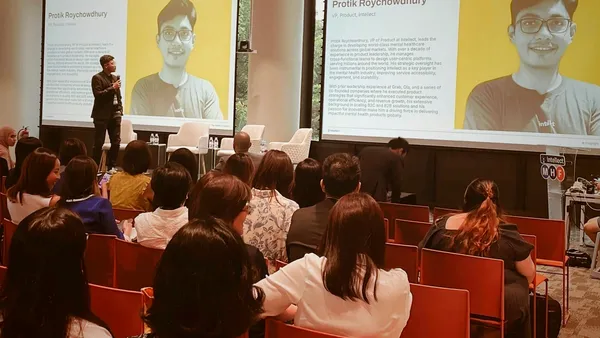
On stage. Credit: courtesy of Protik Roychowdhury. Download ↓
From roadmaps to judgement: what product leaders need in the AI era
AI is absorbing the mechanical parts of product work. What remains — and what organisations now hire for — is judgement. What that looks like in practice, and how to build it in a team.
- Which PM tasks AI is unbundling first, with examples
- The "impact architect" profile and how to hire for it
- How to restructure product orgs around judgement, not process
Building AI products people can trust
Trust in AI is an engineered property with a three-layer architecture: transparency, control, and recourse. Drawn from shipping GenAI features to millions of users in a safety-critical category.
- A reusable trust architecture for any AI feature
- What users actually need to see before they rely on AI
- How trust failures compound — and how to design recovery
What high-stakes products can teach us about trust
Products where failure harms people — health, safety, money — force disciplines that every product team eventually needs. Lessons from mental health platforms and marketplace fraud.
- Compliance as a product surface, not a checkbox
- Harm taxonomies and tiered escalation design
- Why the regulatory moat is a competitive advantage
Scaling product teams without killing product judgement
Scaling a product org from 3 to 20+ without the thinking getting worse. Pods, rituals, and the difference between encoding taste and enforcing process.
- What to standardise and what to deliberately leave loose
- Hiring for judgement at different levels
- The founder-to-operator transition, from someone who made it
AI, personalisation, and the future of care
Three layers of AI personalisation — matching, content, timing — and the ethical constraints that make or break them, from a regulated enterprise SaaS platform in workforce mental health.
- Where personalisation creates value vs where it erodes trust
- The hybrid human-AI care model and why it wins
- Designing AI that challenges users instead of echoing them
Why UX is care: lessons from mental health product design
Design lessons from the highest-stakes UX context there is — onboarding someone in crisis — and what they teach about designing for any vulnerable or stressed user.
- Five UX principles that earn trust under stress
- Designing for cultural context across 20+ languages
- What "user empathy" means when it actually matters